
Ozone is one of the essential tools we use almost daily in our clinic. We especially rely on it during surgical procedures such as tooth extractions, cavitation/NICO surgeries, and implant operations.
In addition to these, we frequently use ozone in the treatment of gum diseases (like periodontitis), tooth sensitivity, deep fillings, pulp capping procedures, and in cases of mouth ulcers and cold sores. Despite using it for years, I realized I hadn’t shared an article about ozone use in dentistry on our website—so I decided to write this piece. In this article, I’ll explain what ozone is, what it does in the body beyond its antimicrobial effects, and how it’s used in dental care.
What is Ozone?
Ozone is a molecule made up of three oxygen atoms (O₃). It forms when oxygen molecules (O₂) are broken down into free oxygen atoms by energy sources such as ultraviolet light or electrical discharge, and these atoms then recombine with other O₂ molecules in the environment. Known for forming the atmospheric layer that protects us from harmful UV rays, ozone is also recognized in medicine and dentistry as a powerful antimicrobial agent and healing booster.
Medical and Dental Use of Ozone
– Timeline Overview
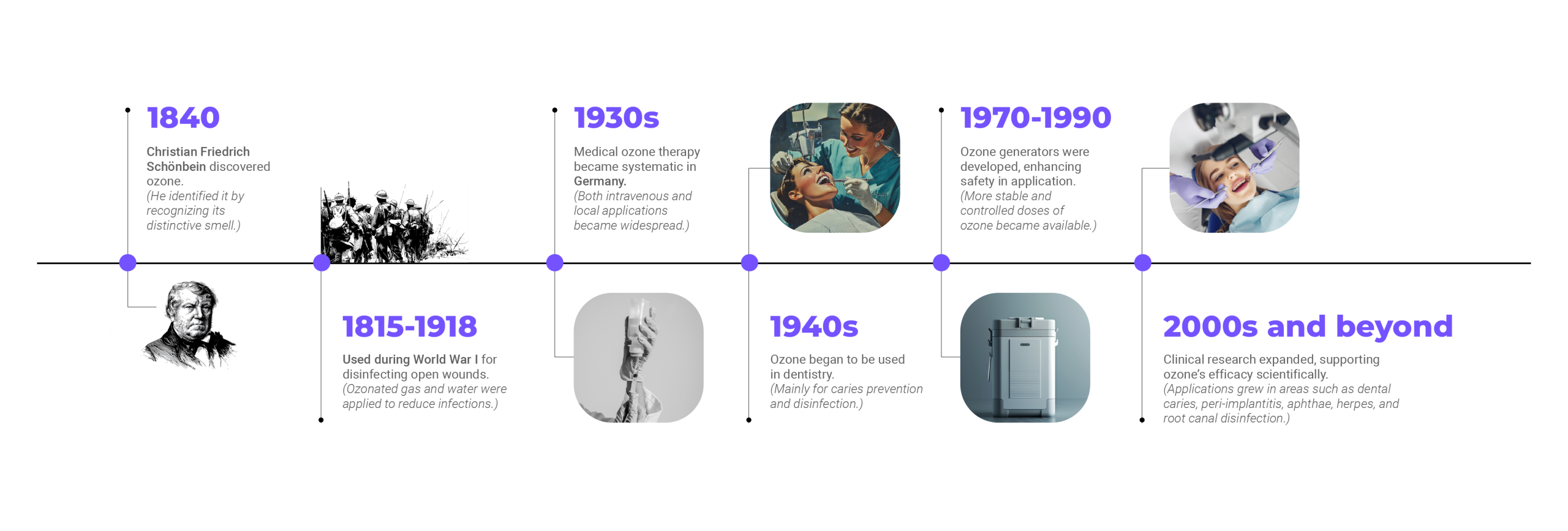
How Does Ozone Work?
Perhaps ozone’s most well-known property is its strong antimicrobial effect. It can rapidly destroy bacteria, viruses, and fungi. As a potent oxidant, it kills these microorganisms with ease. Compared to many antiseptic agents, ozone has a broader spectrum of activity and works faster. The human body’s advanced antioxidant system protects our own cells from potential oxidative damage. Additionally, ozone quickly decomposes back into oxygen molecules and atoms, leaving no harmful residues in tissues. In fact, the resulting O₂ helps re-oxygenate tissues that may be suffering from low oxygen levels, thus accelerating healing.
But ozone doesn’t stop there. Due to its oxidative nature, it also plays a stimulating role in the body’s antioxidant and anti-inflammatory responses. The word “oxidant” might sound negative—but when used in appropriate medical doses, ozone doesn’t cause long-term oxidative damage. Instead, it creates a temporary oxidative stress. If you’re familiar with the concept of hormesis, this may ring a bell: low-dose stressors can actually strengthen the body by enhancing its adaptive and protective mechanisms. What doesn’t kill us makes us stronger…
This mild and temporary oxidative stress triggers various physiological processes. Ozone interacts with different molecules in the body, which then signal various organs about the presence of oxidative stress. This, in turn, boosts the production of antioxidants—compounds that protect our cells from free radicals and oxidative damage.
Furthermore, this upregulation of the antioxidant system also yields anti-inflammatory effects. Pro-inflammatory cytokines decrease, regulatory cytokines increase, and as a result, chronic inflammation is alleviated.
Ozone also activates phagocytes involved in the immune system, promotes cytokine and interferon production, and stimulates the complement system.
In tissues where oxygenation has declined due to chronic inflammation, ozone helps increase red blood cell production and improves their oxygen-carrying capacity. It also enhances nitric oxide production in blood vessels, promoting vasodilation and thus delivering more oxygen to affected tissues.
In addition, ozone has a biosynthetic effect—it stimulates protein synthesis, supports the production of ribosomes and mitochondria, and ultimately promotes tissue regeneration.
Note that ozone does not do all of this directly. Rather, it initiates a chain reaction in the body via the molecules it interacts with—triggering biological responses that lead to these results.
How is Ozone Used in Dentistry?
In dentistry, we apply ozone either as a gas or as ozonated water directly to the treatment area. Because ozone gas is unstable and quickly reverts to oxygen, it must be used shortly after generation. One method to increase its stability is to produce ozonated oil, which patients can then take home and apply themselves in specific cases.
Let’s now take a look at the various treatments where ozone plays a valuable role.
In Which Dental Treatments is Ozone Used?
I use ozone most frequently during surgeries such as tooth extractions, implant placements, bone grafts, sinus lifts, and jawbone cavitations. I apply it both as a gas and in ozonated water. It provides antiseptic action, reducing the need for antibiotics, and supports the body’s healing mechanisms through the chain of biological effects described earlier.
The second most common use in my practice is for pulp capping and treating active caries. Thanks to ozone gas’s ability to penetrate dentin tubules, it eliminates microorganisms, stops decay progression, and enhances treatment success. Moreover, its immune-boosting and antioxidant-stimulating effects support the tooth’s natural healing.
Ozone is also valuable in treating soft tissue inflammation around teeth and implants. We apply the gas directly to infected areas and also use ozonated water in our EMS Airflow device for initial cleanings. In addition to its antiseptic and healing properties, ozone helps disrupt the anaerobic environments in deep pockets where pathogenic bacteria thrive—making it a powerful ally.
For early-stage caries, ozone eliminates bacteria and helps the tooth begin self-repair. It also opens up dentin tubules, making it easier for minerals and remineralizing agents to penetrate the tooth structure.
Ozone has been shown to reduce tooth sensitivity. One study suggested its use could ease dental treatments in children by making them more comfortable.
Applying ozone to these lesions significantly speeds up healing and reduces discomfort.
We also use ozonated water as a mouth rinse before procedures and to prevent biofilm formation in our clinical equipment.
In Summary ozone is not just a disinfectant that kills microbes—it is also a biological support tool that activates the body’s innate healing power. When used with the correct dose and method, it offers a natural complement to treatment and perfectly aligns with the principles of biological dentistry.

